
Since 2019, the Blue Cross Blue Shield of Michigan Cardiovascular Consortium (BMC2) and the Michigan Value Collaborative (MVC) have worked together to improve cardiac rehabilitation utilization in Michigan. This collaboration led to the founding of the Michigan Cardiac Rehabilitation network (MiCR) in 2022, a partnership that endeavors to increase participation in cardiac rehab for all eligible individuals in Michigan through clinical practice sharing, networking, data benchmarking, and the dissemination of resources.
On April 17, MiCR invited practitioners from across Michigan to discuss the evolving role of virtual and hybrid cardiac rehabilitation programming amidst recent legislative wins. In February, Congress advanced the Consolidated Appropriations Act, 2026 (H.R. 7148), which extends Medicare telehealth and in-home cardiopulmonary rehabilitation flexibilities through December 31, 2027. With this extension, cardiac, intensive cardiac, and pulmonary rehab programs in both hospital outpatient and physician office settings can continue delivering services virtually using two-way audio and video technology through the end of 2027. This two-year window gives programs the opportunity to launch or expand hybrid rehab models, try new approaches to reach patients who have difficulty attending in-person sessions, and plan with greater confidence while longer-term policy solutions are explored.
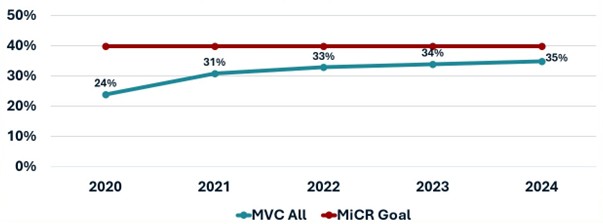
MiCR kicked off the forum emphasizing its mission and the progress made to date in statewide enrollment, with participation rates for eligible cardiac patients across the collaborative increasing from 24% in 2020 to 35% in 2024. Despite progress being made, the state is still short of the MiCR goal of 40% enrollment within 90 days of discharge from eligible procedures (Figure 1), as well as the Million Hearts goal of 70% enrollment.
Figure 1. Trends in cardiac rehab enrollment within 90 days of discharge from AMI, CABG, PCI, SAVR, or TAVR encounter
MiCR conducted a short survey in 2025 about telehealth programming in cardiac rehab to better understand opportunities to close the enrollment gap using telehealth, and how leaders and care teams feel about offering telehealth options. Of the 27 cardiac rehab sites that responded, only two were currently offering some form of virtual cardiac rehab, while some others expressed interest in launching or further investigating virtual service options.
Defining Cardiac Rehab Delivery Models
Prior to initiating a discussion, MiCR reviewed several key definitions to clarify terminology surrounding evolving cardiac rehab delivery models:
- Traditional in-center delivery: synchronous, in-person care
- Virtual delivery: synchronous, real-time, audio-visual communication
- Remote delivery: asynchronous communication between patients and providers
- Hybrid delivery: use of more than one of the methods noted above.
The forum focused primarily on virtual and hybrid delivery approaches given insurance reimbursement stipulations. MiCR emphasized how hybrid models may offer optimal opportunities for organizations to balance flexibility, patient engagement, and clinical oversight.
Health Systems Share Real-World Virtual Cardiac Rehab Experiences
The forum next featured presentations from two Michigan hospitals currently offering virtual or hybrid cardiac rehab programming.
Henry Ford Health
Steven Keteyian, PhD, Bioscientific Clinical Staff in the Division of Cardiovascular Medicine, and Kat Steenson, MS, Clinical Exercise Physiologist, shared insights into Henry Ford Health’s hybrid cardiac rehab model, including their group virtual session structure.
Dr. Keteyian spoke to the importance of designing a virtual program as similar to current in-center facility programming as possible – including using the same forms, outcome measures, even times that the classes are offered. He noted that this simple mindset may help to streamline implementation and workflows. Additionally, Dr. Keteyian encouraged programs considering virtual care to engage physician champions and optimize internal billing support when getting started.
Steenson discussed her experience delivering both traditional in-center and virtual cardiac rehab care and highlighted the important opportunity virtual delivery offers to extend services to patients facing transportation, scheduling, or geographic barriers. She also encouraged sites to develop virtual programming in line with current in-person practices, noting that this makes it easier on the staff ultimately delivering the services.
Michigan Medicine
Next, Samantha Fink, Administrative Manager of Domino’s Farms Cardiology, and Diane Perry, MS, ACSM-CCEP, CHWC, Certified Clinical Exercise Physiologist, outlined Michigan Medicine’s participation in a research pilot for virtual cardiac rehab delivery over the last two years.
Fink highlighted the importance of combining operational planning, process improvement, and patient accessibility initiatives when initially building virtual programs. She noted that while their patients expressed significant interest in virtual options, not all were set up for success—lacking reliable technology, exercise equipment, or appropriate health screenings prior to starting virtual cardiac rehab. Fink also encouraged sites to establish clear emergency protocols and steps for assessing the appropriateness of virtual care.
Perry then shared her perspective as an exercise physiologist on adapting patient support, exercise guidance, and engagement strategies for the virtual environment. She also endorsed a hybrid program, and she spoke in more detail about the importance of in-person initial assessments to confirm the appropriateness of virtual cardiac rehab.
Telehealth as a Tool to Improve Access
After introducing example programs, MiCR Co-Directors Jessica Golbus, MD, MS, and Michael Thompson, PhD, MPH, facilitated a panel discussion on future implementation opportunities, reimbursement considerations, and collaborative learning across Michigan programs.
Throughout the discussion, the panelists repeatedly emphasized that virtual cardiac rehab is not intended to replace traditional in-center rehab but rather enhance access and reduce long-standing barriers to participation. The panelists pointed out that virtual and hybrid approaches may help programs better serve patients with access barriers, such as rural patients, individuals with transportation limitations, working adults, caregivers, and patients with scheduling challenges. Discussion also reinforced that flexibility in care delivery models may improve patient adherence and completion rates. Lastly, the panelists underscored that successful digital transformation in healthcare is less about chasing trends and more about building practical, individualized programs that improve visibility, efficiency, and accessibility.
The webinar concluded with a call for continued innovation and collaboration as health systems explore new ways to improve cardiac rehab participation. With the extension of federal telehealth flexibilities through the end of 2027, presenters encouraged hospitals to consider this time as an opportunity to pilot, expand, and evaluate virtual cardiac rehab programs. For those interested in learning more about virtual cardiac rehab, the following resources may assist your organization’s journey:
- AACVPR Virtual and Remote Cardiac Rehab Delivery Consensus Statement
- UCSF Cardiac Rehab Toolkit
- American College of Cardiology (ACC) Telehealth Workbook
- Keteyian et. al (2022) Scientific Review of the Design and Implementation of a Hybrid Cardiac Rehab Program
- The MCNAIR study on Human-Centered Design to Tailor Telehealth Cardiac Rehab to Diverse Populations
Additionally, you can reference the recording of this forum via YouTube.
MiCR will host a second virtual forum discussion on Tues., June 9, from 12-1 p.m. featuring a demonstration of Henry Ford Health’s group virtual cardiac rehab programming. Registration is available now.
 Arabic
  English
  Spanish
  Chinese